The Blueprint for a Bulletproof Fitness Routine
Introduction
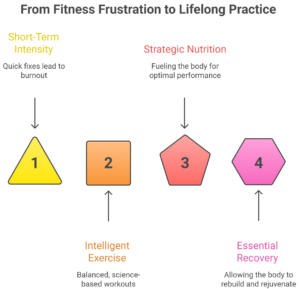
For many, the path to fitness is a frustrating cycle of starts and stops. We begin with a burst of enthusiasm, only to see our ambitious plans derailed by burnout, injury, or the simple friction of a busy life. The promise of a quick fix—be it a fad diet or an extreme workout regimen—often leads back to the same starting line. Lasting success, however, isn’t found in short term intensity but in building a truly sustainable, lifelong practice. The key is a balanced, holistic approach grounded in scientific principles. This guide deconstructs the blueprint for that success, built upon three core pillars that work in harmony: Intelligent Exercise, Strategic Nutrition, and Essential Recovery.
1. The Mindset Foundation: Engineering a Routine You Can’t Quit
Before lifting a single weight or taking a single step, the most critical work is mental. The long term success of any fitness plan is not determined by willpower alone. Scientific research frames willpower as a mind body response, managed by the brain’s prefrontal cortex, that is biologically compromised by stress and sleep deprivation. This section deconstructs the framework required to build a resilient and adaptable mindset, moving beyond mere determination to engineer a routine that becomes an automatic and indispensable part of your life.
1.1. Beyond “Getting in Shape”: Defining Your ‘Why’ with SMART Goals
A vague desire to “get in shape” is a recipe for frustration. Without a clear destination, it is impossible to chart a course. The SMART goal framework transforms ambiguous wishes into powerful, actionable objectives that provide a definitive path and prevent discouragement. SMART stands for:
- Specific
- Measurable
- Achievable
- Relevant
- Time bound

By applying this structure, a nebulous goal like “get fit” can be transformed into a concrete target. For example, instead of a vague aspiration, you might set a goal to “reduce body fat by 5% within 3 months.” A smarter goal would be: “reduce body fat by 5% within 3 months by completing three strength training sessions and two cardio sessions per week.” This clarity provides a sense of purpose, makes progress tangible, and serves as a powerful source of motivation.
1.2. The Science of Automaticity: How to Build Habits That Stick
Lasting change is the product of habits, not heroic, one off efforts. Habits are behaviors that have become so ingrained they are nearly automatic, freeing up your finite willpower for other challenges. This process is governed by a neurological feedback system known as the habit loop, which consists of three parts:
- Cue: The trigger that initiates the behavior.
- Routine: The behavior itself.
- Reward: The benefit gained from the behavior, which reinforces the loop for the future.
To leverage this science, two practical, evidence based strategies are exceptionally effective for integrating new fitness behaviors into your life:
- The 2 Minute Rule: Coined by habit expert James Clear, the 2 Minute Rule involves scaling down any new habit to a version that takes less than two minutes to complete. The goal is to make starting the most difficult part feel effortless. Instead of committing to a 30 minute workout, the goal becomes “put on workout clothes” or “do push ups for two minutes.” This simple act of starting often builds the momentum needed to continue, turning the point of greatest resistance into an easy win.
- Habit Stacking: This technique involves linking a new desired habit to an existing, established routine. The existing habit serves as the cue for the new one. For example, you might decide, “After I brush my teeth in the morning (existing habit), I will meditate for two minutes (new habit).” This leverages established neural pathways to seamlessly integrate the new behavior into your day.

1.3. Overcoming Setbacks with Self Compassion
Even the most dedicated individuals will experience setbacks. A missed workout, a dietary lapse, or a week derailed by unexpected stress is not a sign of failure but a normal part of the process. The crucial factor is how you respond. An “all or nothing” mindset, where one mistake is seen as a total failure, causes many to abandon their goals entirely.
Research shows that a far more effective response is self compassion. This involves treating yourself with the same kindness, care, and understanding you would offer a good friend who is struggling. Instead of engaging in harsh self criticism after a misstep, responding with self kindness promotes greater self improvement intentions and helps you recover from failures more quickly. This isn’t just a mental trick; research shows self compassion has physiological benefits, helping to regulate the autonomic nervous system’s response to stress and promoting a faster recovery from setbacks on a biological level. Acknowledging that imperfection is a shared human experience allows you to treat lapses as learning opportunities, not reasons to quit.
With this psychological foundation in place, we can now turn to the physical components of a sustainable fitness plan.
2. The Three Pillars of a Balanced Fitness Ecosystem
A truly bulletproof fitness routine is not built on exercise alone. It is a synergistic system supported by three interconnected pillars: Exercise, Nutrition, and Recovery. Each pillar is essential to the integrity of the whole; neglecting any one of them will inevitably compromise the entire structure. True sustainability and optimal results are only achieved when these three components are in harmony, working together to build a stronger, healthier, and more resilient you.
2.1. Pillar 1: Intelligent Exercise Programming
A well designed exercise program provides the stimulus your body needs to adapt and grow stronger. It should be comprehensive, balanced, and guided by a core principle of steady advancement.
1. The Building Blocks
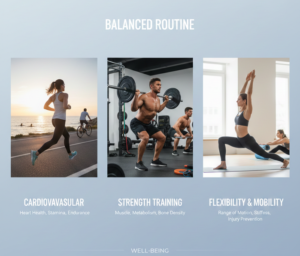
2. A balanced routine incorporates three essential types of exercise, each offering distinct benefits that contribute to overall health and well being.
- Cardiovascular Exercise: Activities like running, cycling, and swimming are crucial for improving heart health, stamina, and endurance. Cardio also aids in weight management and enhances the body’s ability to use oxygen efficiently.
- Strength Training: Using resistance from weights, bands, or your own bodyweight is vital for building lean muscle, increasing metabolism, and improving bone density. It enhances overall functional strength, making daily activities easier and safer.
- Flexibility & Mobility Work: Practices such as stretching and yoga are key to enhancing your range of motion, alleviating stiffness, and reducing the risk of injury. This work ensures your joints and muscles function optimally through their full potential.
3. The Engine of Progress
4. To ensure continued improvement and avoid plateaus, your training must be guided by the principle of Progressive Overload. This means that for your body to adapt, you must consistently and gradually increase the stress placed upon it over time. This can be achieved by systematically:
- Increasing the weight you lift.
- Increasing the number of repetitions or sets.
- Decreasing the rest time between sets.
- Increasing the frequency of your workouts. The key is a systematic, gradual progression that continually challenges your body just enough to stimulate change.
5. Structuring Your Week
6. A workout split is simply how you organize your training sessions throughout the week. The best split for you depends on your experience, goals, and available time. Below is a comparison of three common and effective structures.
| Workout Split | Typical Frequency | Best For |
| Full Body | 2 3 days/week | Beginners or those with limited time |
| Upper/Lower | 4 days/week | Intermediate individuals seeking balance between frequency and recovery. |
| Push/Pull/Legs (PPL) | 3 6 days/week | Intermediate to advanced individuals wanting to train with high volume and frequency. |
2.2. Pillar 2: Fueling for Performance and Recovery
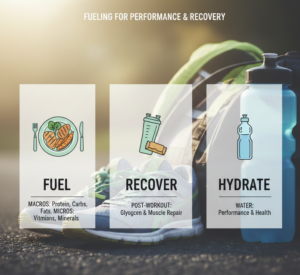
Think of nutrition as the foundation of your results. It is both the fuel that powers your performance and the raw material that allows your body to recover, adapt, and grow stronger. Food should be viewed not as an enemy to be fought, but as a strategic tool for enhancing performance and accelerating recovery. A sustainable nutritional approach focuses on:
- Macronutrient and Micronutrient Intake: Ensuring a proper balance of protein, carbohydrates, and fats (macros) provides the energy for exercise and the building blocks for muscle repair. A diet rich in vitamins and minerals (micros) supports overall bodily function and immune health.
- Post Exercise Nutrition: Consuming a combination of protein and carbohydrates after a workout is critical. This helps replenish glycogen stores—the body’s primary fuel source for exercise—and provides the necessary amino acids to repair and build muscle tissue.
- Hydration: Finally, never underestimate hydration. While seemingly basic, optimal hydration is a foundational requirement for health and performance that is easily overlooked but critical for everything from nutrient delivery to temperature regulation.
2.3. Pillar 3: The Unsung Hero of Results—Recovery
Muscles don’t grow during workouts; they grow during recovery. This critical phase is when your body adapts to the stress of training, repairs damaged tissues, and becomes stronger. Yet, it is the most frequently neglected pillar of fitness. Effective recovery incorporates two key approaches:
- Passive Recovery (Rest Days): These are days of complete rest from intense exercise. Passive recovery is essential for allowing muscles to fully repair and grow stronger. Taking 1 2 full rest days per week, depending on your training intensity, is crucial for preventing overtraining, mental burnout, and injury.
- Active Recovery: This involves low intensity, low impact activity on non training days, such as walking, light cycling, or gentle yoga. Active recovery enhances circulation, which helps deliver nutrients to muscles and clear metabolic waste products. This can reduce soreness and improve flexibility without placing significant stress on the body.
Ultimately, the most potent recovery tool available is quality sleep. It is during deep sleep that the body undergoes the majority of its repair processes, regulates hormones essential for muscle growth, and consolidates learning.
Understanding these pillars provides the theoretical knowledge; the next step is learning to apply it amidst the chaos of everyday life.
3. From Plan to Practice: Mastering Consistency in the Real World
Even the most perfectly designed fitness plan is useless if it cannot withstand the unpredictability of daily life. Time constraints, fluctuating energy levels, and unexpected demands can easily derail a rigid routine. The key to true, long term consistency is not perfect adherence but intelligent adaptability. This section provides the practical tools to ensure your fitness routine can bend without breaking, allowing you to stay on track no matter what life throws your way.
3.1. Autoregulation: Learn to Listen to Your Body
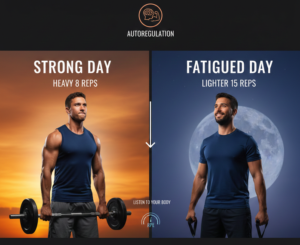
Autoregulation is the practice of adjusting your workout based on your body’s readiness on any given day. Life is not linear; your training shouldn’t be either. Some days you will feel strong and energized, while on others, due to stress or poor sleep, you may feel fatigued.
Instead of skipping a workout completely when you’re not feeling 100%, autoregulation allows you to simply “switch the goals for the day.” For example, if you planned a heavy strength session with sets of 8 reps but feel run down, you can modify the workout by reducing the weight and increasing the reps to a lighter set of 15. This gives your body a break from high intensity while still accumulating quality training volume and, most importantly, maintaining the habit of consistency. This approach acknowledges that progress is not linear. By matching your effort to your body’s daily capacity, you prevent the overtraining and burnout that often leads to abandoning a routine altogether, ensuring long term consistency. Using a tool like the Rate of Perceived Exertion (RPE) scale—where you rate how hard an exercise feels—can help guide these real time adjustments.
3.2. Slaying the “No Time” Dragon: The Power of Mini Workouts
One of the most common obstacles to consistency is a perceived lack of time. The solution lies in shifting your mindset from all or nothing workouts to embracing the “minimum viable workout”—a routine focused on consistency over duration.
Research shows that breaking down a longer workout into shorter sessions is a valid and effective strategy. A 30 minute workout can be just as beneficial when performed as two 15 minute or three 10 minute “mini workouts” spread throughout the day. These short bursts of activity can be fit into a coffee break, while food is in the microwave, or during a TV commercial break. This approach is effective because the physiological benefits of exercise are cumulative; these small, consistent efforts add up over time to produce significant results.
3.3. Tracking Your Journey for Sustained Motivation
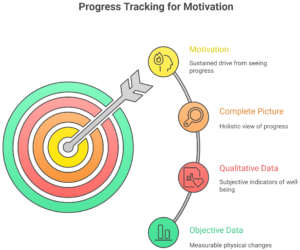
Tracking your progress provides tangible, visible proof of your hard work, which is a powerful tool for sustaining motivation. It also provides the data needed to make informed adjustments to your plan. For a complete picture, it’s essential to monitor both objective and qualitative data.
- Objective Data: These are the hard numbers that show measurable change.
1. Workout logs detailing sets, reps, and weight lifted.
2. Body measurements (e.g., chest, waist, hips).
3. Body fat percentage. - Qualitative Data: These are the subjective yet equally important indicators of progress.
1. How your clothes fit.
2. Improvements in your daily energy levels.
3. Better sleep quality.
Reviewing this complete picture—not just the number on the scale—provides undeniable proof that your efforts are paying off. Seeing these changes in black and white fuels long term commitment and transforms motivation from a fleeting feeling into a self sustaining cycle of success.
Conclusion: Building Your Lifelong Fitness Practice
A sustainable, bulletproof fitness routine is not about achieving perfection. It is about the intelligent and flexible integration of a resilient mindset, the three synergistic pillars of exercise, nutrition, and recovery, and the real world adaptability to navigate life’s inevitable challenges. By moving beyond the myth of the quick fix and embracing a balanced, evidence based approach, you can build a system that supports your health for a lifetime. Embrace fitness not as a destination to be reached, but as a practice to be honed—a continuous and rewarding journey of discovering just how capable you can be.