Schedule your workout to achieve optimal results
For anyone committed to a fitness regimen, the question of when to exercise is a common and often confusing topic. While the most crucial element of any successful fitness plan is consistency, a growing body of scientific evidence reveals that the timing of a workout can significantly influence specific outcomes. This is not a matter of popular opinion but of physiological science, governed by the body’s natural internal clock—a field of science known as chronobiology. This article will delve into the science of circadian rhythms to help you align your workout schedule with your primary fitness and health goals.
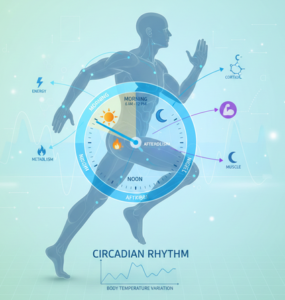
At the heart of this science is the concept of circadian rhythms, the 24 hour physiological cycles that govern nearly all our bodily functions, from core body temperature and metabolism to the release of key hormones like testosterone and cortisol. These internal clocks are orchestrated by a master regulator in the brain called the suprachiasmatic nucleus, which keeps our bodies in sync with the daily light dark cycle.
Ultimately, the optimal time to exercise is not a one size fits all answer. Instead, it depends on a careful consideration of your individual goals, whether you are aiming for fat loss, muscle gain, peak athletic performance, or even a better night’s sleep. To strategically time your workouts for maximum benefit, you must first understand how daily fluctuations in core body temperature and key hormones prime your body for different challenges.
2. The Body’s Clock: How Circadian Rhythms Dictate Your Physiology
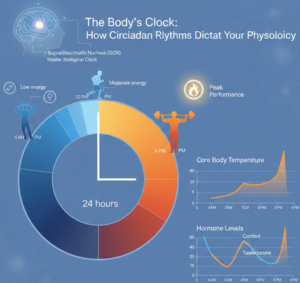
To strategically time your exercise, it is essential to first understand the foundation upon which this science is built: your circadian rhythms. Far from being static, your body is in a constant state of flux over a 24 hour period. Nearly all physiological processes, from your metabolism and hormone levels to your neuromuscular function, follow this predictable daily cycle. This master biological schedule is regulated by the suprachiasmatic nucleus in the brain, which orchestrates your sleep wake cycle and other critical biorhythms. Two of the most significant daily fluctuations relevant to exercise are core body temperature and hormone levels.
- Core Body Temperature Your core body temperature follows a distinct circadian rhythm, rising steadily throughout the day and typically reaching its peak in the late afternoon or early evening. This natural warming has a direct and beneficial impact on physical performance. An elevated core temperature enhances energy metabolism, improves the flexibility and compliance of your muscles, and facilitates more efficient muscle contractions by optimizing the interaction between actin and myosin filaments—the fundamental process of force production.
- Hormonal Environment The body’s hormonal landscape also shifts dramatically over 24 hours. Key hormones that influence muscle adaptation, such as the anabolic (muscle building) hormone testosterone and the catabolic (muscle breakdown) hormone cortisol, display clear circadian rhythms. Cortisol levels peak shortly after awakening, promoting alertness and contributing to wakefulness, and then gradually decline throughout the day. This creates a different internal environment for a morning workout compared to an evening one.
These daily physiological fluctuations mean that your body is primed for different types of activity at different times. A morning workout capitalizes on a unique metabolic and hormonal state, while an evening session can leverage a natural peak in physical readiness.
3. The Morning Advantage: Maximizing Fat Loss and Building Routine
The morning presents a strategic window for achieving specific fitness goals, particularly for those focused on fat oxidation and the critical task of building a lasting exercise habit. By leveraging the body’s post absorptive (fasted) state after an overnight fast, a morning workout can trigger unique metabolic benefits that are less pronounced later in the day.
Synthesizing the available evidence reveals several primary advantages of morning exercise:
- Enhanced 24 Hour Fat Oxidation: Research shows that exercise performed before breakfast in a fasted state significantly increases total fat burning over a 24 hour period. One study using a metabolic chamber found that individuals who exercised in the morning oxidized approximately 717 kcal from fat over 24 hours, compared to only 432 446 kcal for those who exercised in the afternoon or evening, even when total daily energy intake was identical. This powerful effect is linked to creating a transient carbohydrate deficit, forcing the body to rely more heavily on its fat stores for fuel.
- Superior Fat Loss for Women: A study by Arciero et al. demonstrated a clear, gender specific benefit for morning exercise. Women who followed a multi modal training program in the morning experienced significantly greater reductions in total body fat ( 5% vs 2%) and, most notably, abdominal fat ( 10% vs 3%) compared to women who performed the exact same workouts in the evening.
- Improved Blood Pressure in Women: The same study found morning exercise was more effective for cardiovascular health in women, leading to a significant 10% reduction in blood pressure, a greater improvement than that seen in the evening group.
- Promoting Consistency: Beyond physiology, morning exercise may offer a behavioral advantage. A recent study found that prescribing a consistent exercise time—whether in the morning or evening—resulted in individuals accumulating more minutes of moderate to vigorous physical activity (MVPA) compared to those who were free to choose their workout time each day. For many, the morning offers fewer scheduling conflicts, making it easier to establish the routine necessary for long term adherence.
While morning workouts offer clear benefits for fat loss and habit formation, the body’s internal clock favors a different time of day when the goal is to achieve peak power and strength.

4. The Evening Peak: Unlocking Maximum Strength and Performance
The late afternoon and early evening are widely regarded as the body’s “peak performance window,” a time when physiological conditions align to support maximum strength, power, and athletic skill. This phenomenon is directly linked to the circadian peak in core body temperature, which enhances overall neuromuscular function and metabolic efficiency, allowing you to get the most out of strength and power training. This performance peak is not only driven by core body temperature but also by a more favorable hormonal state, with the morning’s catabolic cortisol spike having long subsided.
An evaluation of performance based studies highlights the distinct advantages of timing your workouts for the evening:
- Superior Strength and Power: In line with the daily peak in core body temperature, metrics of anaerobic power and muscular strength consistently reach their zenith in the early evening. Studies have demonstrated superior physical performance in the afternoon and evening across various measures, including peak power and mean power during high intensity cycling tests. This extends to sport specific skills, with one study on professional soccer players finding a significantly higher number of successful passes and ball interceptions during evening sessions compared to morning sessions.
- Targeted Gains for Men and Women: Research has identified powerful, gender specific benefits for evening training. In a 12 week study, women who exercised in the evening saw dramatically greater gains in upper body muscle strength (a 16% increase vs. 9% in the morning group), as well as superior improvements in muscular power and endurance. For men, evening exercise was more effective at increasing fat oxidation and reducing feelings of fatigue compared to morning workouts. While fasted morning exercise appears to boost overall 24 hour fat metabolism, this specific study (Arciero et al.) found that for men performing multi modal training in a fed state, evening workouts were superior for fat oxidation during the training period and for reducing feelings of fatigue.
- Cardiovascular and Mood Benefits: Evening exercise appears particularly beneficial for cardiovascular health in men, with one study showing it produced a significantly greater reduction in systolic blood pressure ( 12%) compared to morning exercise ( 3%). Furthermore, several studies report that evening training sessions are associated with a more favorable mood state, lower levels of perceived fatigue and stress, and greater overall enjoyment of the workout.
Despite these clear performance benefits, many people worry that exercising late in the day will interfere
with their ability to get a good night’s sleep. As we will see, this common concern is largely unsupported by scientific evidence.

5. Myth vs. Reality: The Impact of Evening Exercise on Sleep
One of the most persistent pieces of fitness advice is to avoid exercising in the evening for fear of disrupting sleep. This guidance can be a major barrier for individuals whose work or family schedules only permit late day workouts. Fortunately, a robust body of recent scientific evidence has systematically examined this claim and found that, for most healthy adults, this long held belief is largely a myth.
Systematic reviews and meta analyses of the research have established a clear consensus: evening exercise, including sessions of both moderate and high intensity, does not negatively affect sleep and may, in fact, confer small to moderate benefits. To clarify this relationship, it is helpful to break down the specific findings:
- No Negative Impact: Multiple meta analyses confirm that evening exercise does not disrupt key sleep metrics. It does not negatively affect total sleep time, sleep efficiency (the percentage of time in bed you are actually asleep), or sleep onset latency (the time it takes to fall asleep). In fact, moderate intensity exercise in the evening shows a trend toward improving overall sleep quality.
- A Potential Exception: The one important caveat is that vigorous exercise concluding less than one hour before bedtime may impair sleep quality for some, potentially reducing sleep efficiency and total sleep time by keeping the body in a heightened state of arousal.
- Positive Outcomes: Far from harming sleep, evening exercise can be beneficial. Some studies have shown that it may increase the amount of time spent in slow wave sleep, the deepest and most restorative stage of sleep. This indicates that a workout completed a few hours before bed can actually enhance sleep quality compared to not exercising at all.
With the understanding that timing is goal dependent and evening exercise is perfectly compatible with healthy sleep, we can now synthesize this information into a practical guide.

6. Your Goals, Your Schedule: A Practical Guide to Timing Your Workouts
The scientific evidence makes it clear that while consistency is paramount, the timing of your exercise can be a powerful tool to enhance specific outcomes. To distill this information into a simple, actionable framework, this section provides a goal oriented guide. Use this table to align your workout schedule with what you want to achieve, while always remembering to choose a time that you can maintain consistently.
| Primary Goal | Optimal Timing & Rationale |
| Maximize Fat Loss | Morning (before breakfast). Exercising in a fasted state significantly boosts 24 hour fat oxidation by depleting glycogen stores. This effect is particularly pronounced in women for reducing total and abdominal fat. |
| Peak Athletic Performance (Strength & Power) | Afternoon/Evening. Peak performance aligns with the daily peak in core body temperature, which improves muscle function, energy metabolism, and power output. Women see greater gains in upper body strength with evening training. |
| Improve Blood Pressure | Evening for Men, Morning for Women. Studies show men experience a greater reduction in systolic blood pressure with evening exercise. For women, morning exercise was more effective at lowering blood pressure. |
| Enhance Sleep Quality
| Evening (but not within 1 hour of bedtime). Contrary to common belief, studies show evening exercise does not disrupt sleep and may improve its quality. Vigorous activity should be completed more than an hour before sleep. |
| Build a Consistent Habit
| The time you can consistently maintain. Research shows that a consistent routine (whether morning or evening) leads to more total physical activity than a variable schedule. The best time is the one that fits your life. |
While this table provides clear, goal oriented guidance, the science reveals that the optimal choice can also depend significantly on gender, a crucial factor we will address in the conclusion.
7. Conclusion: Consistency is the Ultimate Chronometer
This exploration of exercise timing reveals that our internal biological clock is a powerful ally in the pursuit of fitness and health. Strategically scheduling workouts in the morning can accelerate fat loss, particularly for women, while evening sessions can unlock superior gains in strength, power, and athletic performance. Understanding these nuances allows for a more personalized and effective approach to training, turning timing into a tool for targeting specific physiological adaptations.
However, it is crucial to place these findings in their proper context. While timing can provide a meaningful edge for achieving specific goals, the most critical factor for long term health and fitness remains unwavering consistency. The benefits of a perfectly timed but sporadic workout are negligible compared to the cumulative impact of a regular, sustained routine. As research on habit formation confirms, the best time to exercise is ultimately the time you can stick with.
Therefore, use the information presented here as a guide to experiment with your own schedule and goals. Listen to your body, observe your results, and find what works for you. But above all, prioritize the creation of a consistent routine, because in the world of fitness, adherence is the ultimate chronometer for success.