Group Fitness vs. Personal Training
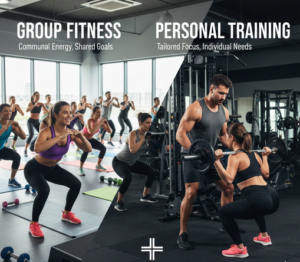
Deciding how to invest your time and energy at the gym can be a significant crossroads on your health journey. Many find themselves weighing two popular options: the vibrant, communal energy of group fitness classes against the focused, tailored approach of personal training. Both paths offer valuable structure and accountability, promising a more guided experience than working out alone. However, the “best” choice is not universal; it is a deeply personal decision that hinges on a unique mix of your specific goals, personality, and practical needs.
This guide will navigate you through a science backed comparison of these two effective training modalities. By examining the evidence behind the psychological benefits of group settings and the physiological outcomes of supervised training, you can make an informed and effective decision that aligns perfectly with your fitness journey.
1. The Power of the Pack: Unpacking the Benefits of Group Fitness
The true power of group fitness lies not in the reps and sets, but in the powerful social and psychological forces it unleashes to foster long term consistency and wellness. The shared experience creates a motivational ecosystem that research shows can have a profound impact on mental and emotional health, often surpassing the benefits seen in solo exercise.
A compelling study published in The Journal of the American Osteopathic Association examined the effects of different training environments on a high stress population: medical students. The findings were striking. Participants who engaged in a 12 week group exercise program reported a significant 26.2% decrease in perceived stress. They also saw marked improvements in their mental (12.6%), physical (24.8%), and emotional (26%) quality of life. In contrast, those who exercised individually—despite working out twice as long on average—saw no significant changes in any measure, except in mental quality of life. This suggests that the communal aspect of group exercise provides unique benefits that amplify its positive effects.
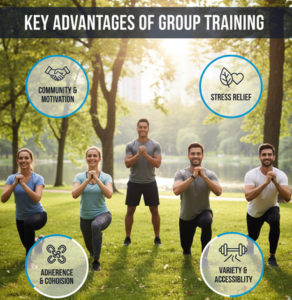
Key Advantages of Group Training
- Enhanced Motivation and Community: The shared energy and camaraderie of a class foster a powerful sense of community and support. This environment is not only fun and engaging but also highly motivating, encouraging long term participation and consistency.
- A Scientific Prescription for Stress Relief: Research confirms that working out in a group can lower stress by over 26%. This directly links the communal benefits of exercising together to improved mental and emotional well being.
- Increased Adherence Through Cohesion: It’s not just exercising with others that boosts adherence, but the quality of the group dynamic. A meta analysis of 44 studies found that participation in classes with high task cohesiveness—what researchers call “true groups” where members feel a shared purpose—was scientifically superior for long term consistency compared to standard classes.
- Variety and Accessibility: Group classes offer a wide variety of workouts, from high intensity interval training to yoga, allowing you to explore different styles without a long term commitment. They are also generally more cost effective and are often included with a standard gym membership.
While the mental and social benefits of group settings are powerful, a more individualized approach offers distinct advantages for achieving specific physical outcomes.
2. The Precision Approach: Why Personal Training Delivers Targeted Results
When your goals are specific and your time is limited, personal training shifts from a luxury to a strategic necessity. This one on one approach provides expert guidance tailored to your unique body, abilities, and objectives, ensuring that every minute of your workout is optimized for maximum impact. This precision approach accelerates results, and as research shows, is also superior for preventing injuries due to its focus on proper form and technique.
Research consistently demonstrates the superior physical outcomes associated with supervised training. A 10 week randomized controlled trial comparing supervised (in person), app guided, and self guided resistance training revealed significant differences. The supervised group didn’t just get stronger; they fundamentally transformed their body composition in ways the other groups did not. They achieved significantly greater improvements in their squat 1 repetition maximum and maintained the highest adherence rate at 88.2%. Crucially, the supervised group was the only one to experience statistically significant gains in fat free mass, adding an average of 1.4 kg of lean tissue and highlighting a key differentiator from app guided or self guided approaches. Other studies reinforce these findings, showing that individuals working with a personal trainer achieve significant fat reduction and performance improvements not seen in self directed training.
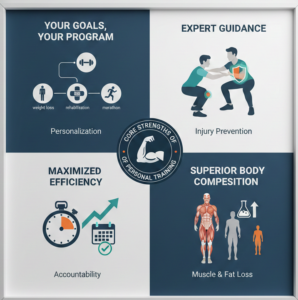
Core Strengths of Personal Training
- Your Goals, Your Program: The Power of Personalization: A personal trainer designs a program built entirely around you. Whether your goal is significant weight loss, rehabilitating an injury, or preparing for a specific event like a marathon, the plan is tailored to your needs.
- Expert Guidance and Injury Prevention: One on one attention ensures you maintain proper form and technique for every movement. This is critical for maximizing the effectiveness of each exercise and, most importantly, for preventing injuries.
- Maximized Efficiency and Accountability: A personal trainer creates the most direct and efficient path to hitting your goals. Furthermore, the accountability of a scheduled, paid session makes you far less likely to skip a workout, ensuring consistent progress.
- Superior Body Composition Changes: As the research shows, supervised resistance training is the most effective modality for increasing lean muscle mass and fat free mass, leading to tangible changes in your physique and metabolism.
With a clear understanding of what each option excels at, a direct comparison can help you weigh the trade offs based on your personal priorities.
3. At a Glance: Group Fitness vs. Personal Training
Seeing the key differentiators side by side can crystallize your decision making process. This table provides a quick, head to head comparison to help you weigh the pros and cons based on the factors that matter most to you.
| Factor | Group Fitness | Personal Training |
| Customization | Low; a generalized workout designed for a broad audience. | High; a fully tailored program designed for your specific goals, body, and needs. |
| Cost | Lower; often included in a gym membership or available at an affordable class rate. | Higher; a premium investment for one on one expert guidance. |
| Accountability | Relies on social motivation and the energy of the group to foster consistency. | High; based on a direct, scheduled appointment with a trainer who tracks your progress. |
| Social Environment | Highly social, energetic, and community driven. Great for meeting new people. | Private and focused; interaction is primarily between you and your trainer. |
| Scheduling | Fixed class times, offering structure but less flexibility. | Highly flexible; sessions can be scheduled to fit your personal availability. |
| Best For… | General fitness, stress relief, social motivation, variety, and budget conscious individuals. | Specific goals (weight loss, muscle gain, injury rehab), learning proper technique, and maximizing efficiency. |
The choice isn’t always binary. The modern fitness landscape offers compelling hybrid models that allow you to capture the benefits of both worlds.
4. Finding the Middle Ground: The Rise of Hybrid Models
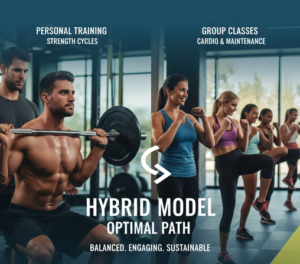
The modern fitness landscape shows that the most effective solution isn’t always a binary choice. Hybrid models that blend individual and group training are not just a compromise; they are often the optimal path for long term, multi faceted success. This approach allows you to periodize your focus—using personal training for specific strength cycles and group classes for maintenance or cardio phases—creating a balanced, engaging, and sustainable routine.
4.1 Small Group Training
Small group training occupies the sweet spot between a large class and a one on one session. Typically involving a personal trainer working with a limited group of 3 10 people, this format offers a compelling value proposition. It provides more personalized attention and tailored exercises than a large class, ensuring better form and progression. At the same time, it is more affordable than individual training and retains the motivational dynamic of a group setting. Research shows that participants in this model report not only greater motivation and life satisfaction but also better exercise self efficacy—the belief in one’s ability to succeed—which is a powerful predictor of long term adherence.
4.2 A Combined Approach
Another highly effective strategy is to combine both training types into a well rounded weekly routine, leveraging each format for its core strengths. For example, you might:
- Attend group classes for your cardio workouts and to tap into the fun, social energy that relieves stress.
- Work with a personal trainer once or twice a week to focus on specific strength goals, master complex lifts, or improve your technique.
This balanced approach targets your physical and mental health needs, creating a comprehensive and enjoyable fitness plan.
5. Making the Final Decision: A Framework for Your Choice
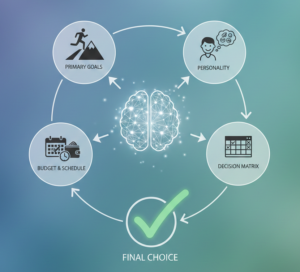
Ultimately, the most effective choice is the one that aligns with your unique makeup. This final step is about self assessment. Use this framework to connect your fitness plan to your goals, personality, and lifestyle for the best chance of long term success.
5.1 Evaluate Your Primary Goals
The nature of your goals is a primary determinant of which path is right for you.
- Choose Personal Training if: You have specific, measurable objectives. This includes training for an event like a marathon, pursuing significant weight loss, rehabilitating an injury, or needing to learn foundational strength training techniques correctly and safely.
- Choose Group Fitness if: Your goals are geared toward general fitness, staying active, and mental well being. It’s an excellent choice if you’re seeking stress relief, variety, or a fun, social component to your exercise routine.
5.2 Align With Your Personality
Research shows that matching your workout style to your personality boosts enjoyment and consistency—the two key ingredients for any successful fitness plan. The goal is to reduce friction between your innate tendencies and your fitness routine. The less willpower you need to expend just to show up, the more energy you’ll have for the workout itself.
- Extroverted Individuals: Often thrive in the high energy, social atmosphere of group classes. They draw motivation from the collective energy, the music, and the camaraderie of working out alongside others.
- Introverted or Neurotic Individuals: May prefer a private, one on one setting to focus without the distraction or potential self consciousness of a large group. Research also indicates that those prone to anxiety are drawn to workouts that reduce stress, a benefit that can be precisely targeted in a personalized plan.
5.3 Align Your Plan with Reality: Budget and Schedule
Your decision must also be practical to be sustainable.
- Personal training offers maximum scheduling flexibility but comes at a higher cost.
- Group fitness is more budget friendly but requires you to adhere to a fixed class schedule.
5.4 Using a Decision Matrix
If you’re still undecided, a simple decision matrix can help you make a logical choice. This structured tool removes emotional bias and clarifies the best path forward.
- List your options: Personal Training, Group Fitness, Small Group Training, Hybrid Model.
- List your criteria: What matters most to you? Examples include Cost, Motivation, Customization, Schedule Flexibility, and Fun.
- Score each option against each criterion (e.g., on a scale of 1 to 5).
- Tally the scores. The option with the highest total score is likely the best logical fit for you right now.
6. Conclusion: The Best Workout Is the One You’ll Stick With
In the debate between group fitness and personal training, there is no universal winner. Each modality offers a powerful set of benefits, and the optimal choice is entirely dependent on a thoughtful assessment of your individual goals, personality, budget, and schedule. One person may thrive on the targeted precision of a personal trainer, while another finds lasting motivation in the shared energy of a group class.
As a coach, my ultimate measure of a successful program is consistency. The data points the way, but your genuine enjoyment is what will keep you showing up long after the initial motivation fades. Use this guide not as a final verdict, but as a framework to experiment and build a plan that works for you. The most effective fitness plan is not determined by trends or what works for someone else—it is the one that becomes a consistent, fulfilling, and sustainable part of your life.